

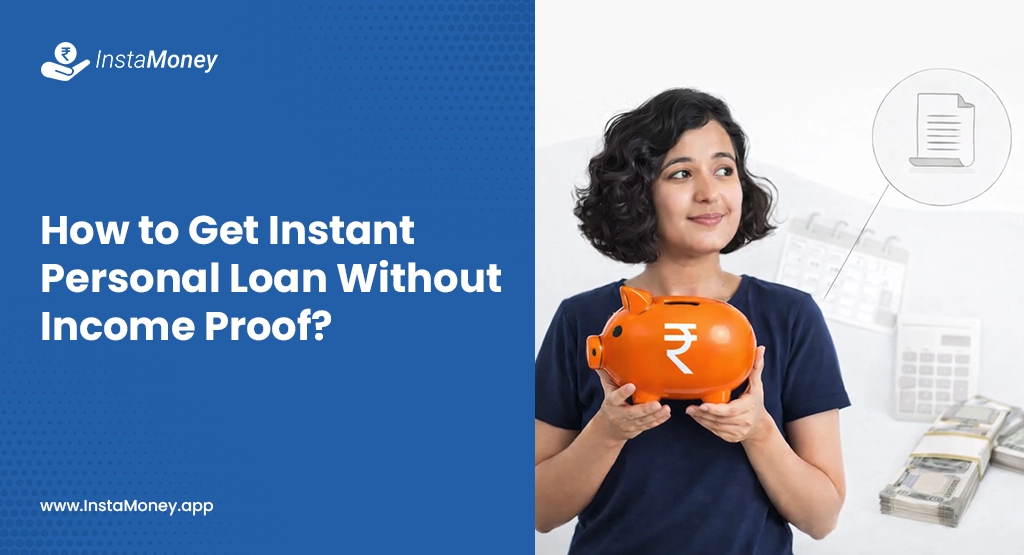
Do you need cash right away but don’t have proof of income, like salary slips?
Don’t worry; millions of Indian freelancers, self-employed people, gig workers, and people with non-traditional income sources get loan rejection by traditional banks all the time because they don’t have standard proof of income.
NBFCs and Fintech platforms now make it possible to get an instant personal loan without income proof.
Modern lenders no longer use old-fashioned ways to check things. They look at your credit history, bank statements, digital transactions, and other signs of your ability to pay back the loan.
In this guide, we’ll look into 8 ways to get a personal loan without income proof. We’ll also talk about who can get one, and how to apply in a way that works.
What Is a Personal Loan Without Income Proof?
A personal loan without income proof is an unsecured loan that lenders approve using alternative verification methods instead of traditional salary slips.
Such lenders don’t ask for W2s or tax returns. Instead, they look at your credit score, recent bank statements, transaction history, employment record linked to your Aadhaar or PAN card, and your relationship with the bank.
Who Qualifies for a Loan Without Income Proof?
These loans work well for specific borrower profiles:
- Freelancers and gig workers who earn variable income from project-based work
- Self-employed professionals like consultants, contractors, and business owners
- Small business owners running companies without traditional salary structures
- Individuals with alternative income from rentals, investments, or pensions
- Retired persons lacking formal pension documentation
- Recent graduates starting careers without extensive income history
- Non-salaried professionals in commission-based roles
If you fall into any of these categories, the methods below can help you access funds quickly.
List of 8 Ways to Get an Instant Personal Loan Without Income Proof
Getting an instant personal loan without income proof is possible when you focus on what lenders actually check. By using any of the below strategies, you can still qualify for a loan even without standard income documents.
1. Non-Banking Financial Companies (NBFCs) and Fintech Lenders
Digital lending platforms and non-bank financial companies (NBFCs) have more flexible rules than regular banks. They’ve made algorithms that use unusual data points to figure out if someone is creditworthy.
How it Works: Instead of looking at your pay stubs, NBFCs and fintech apps look at your digital footprint, which includes your online shopping habits, utility bill payments, credit card spending history, and phone usage patterns.
Why it’s effective: These lenders have adapted to India’s diverse economy. They understand that many hardworking professionals lack formal documentation but maintain consistent financial behavior. Their underwriting teams use machine learning to make decisions in minutes.
Typical terms:
- Interest rates: 12-36% annually.
- Loan amounts: ₹5,000 to ₹5 lakhs.
- Approval time: 1 hour to same-day disbursal.
- Best for: Those who want the fastest approval with minimal paperwork.
2. Peer-to-Peer (P2P) Lending Platforms
P2P platforms let people borrow money directly from individual lenders, cutting out the need for traditional financial middlemen. In India, this model is becoming more popular.
How it works: You make a profile on an RBI-approved peer-to-peer lending platform amd explains your loan needs. Investors look at your profile and decide whether or not to give you money for your loan. The platform takes care of everything else.
Why it works: Individual lenders often have more flexibility than banks. They might think about things that banks don’t, like your business plan, your reputation, or your standing in the community. The rules for documentation are not as strict as well.
Typical terms:
- Interest rates: 10-25% annually.
- Loan amounts: ₹10,000 to ₹10 lakhs.
- Approval time: 3-7 days.
- Best for: Those willing to wait a week for potentially lower rates from individual investors.
3. Pre-Approved Loans
A lot of banks and NBFCs offer instant pre-approved personal loans to people who already have credit cards. They consider your spending history and repayment history as an alternative of proof of income.
How it works: The company that issues your credit card looks at your payment history, how much of your credit limit you use, and how you pay your bills. If you’ve kept up with your payments, they’ll automatically offer you a personal loan. You can find out if you qualify with just a few clicks on your bank’s app.
Why it works: Banks already trust you as a credit customer. They have months or years of records showing that you pay your bills on time.
Typical terms:
- Interest rates: 10-20% annually.
- Loan amounts: ₹25,000 to ₹10 lakhs.
- Approval time: Instant to 1 hour.
- Best for: Existing credit card holders with clean payment histories.
4. Adding a Co-Applicant or Guarantor
Applying jointly with someone who has regular income and good credit significantly improves your chances. The co-applicant’s income and CIBIL score strengthen your application.
How it works: You and your co-applicant apply together. Both names appear on the loan agreement, and both are legally responsible for repayment. Lenders assess the combined income and creditworthiness of both parties.
Why it’s effective: Lenders see reduced risk. If one borrower faces hardship, the other can cover payments. This simple addition often makes the difference between rejection and approval.
Typical terms:
- Interest rates: 10-20% annually.
- Loan amounts: ₹25,000 to ₹25 lakhs.
- Best for: Those with supportive family or business partners willing to co-sign.
5. Leveraging a Strong CIBIL Score
Your CIBIL score is a credit history summary on a scale of 300-900. A high score proves you’re financially responsible and reduces a lender’s risk dramatically.
How it works: Maintain a CIBIL score of 750 or above by paying all bills on time, keeping credit card balances low (under 30% of limit), and avoiding defaults. With a high score, many lenders approve loans based solely on creditworthiness, bypassing income verification entirely.
Why it’s effective: Your credit score is objective proof of your payment habits. It is more crucial than income documents because it shows what you’ve actually done, not what you claim to do.
Typical terms:
- Interest rates: 10-15%
- Best for: Those already managing credit well or willing to spend 3-6 months building their score.
6. Alternative Income Documentation
If you have income that’s not documented in traditional payslips, document it and present it to lenders. It will increase the chance of your loan approval.
How it works: Gather documents that prove your income, business registration, GST certificates, recent invoices from clients, bank statements showing deposits, rent agreements proving rental income, or pension correspondence. Each lender has different requirements, so check with multiple lenders.
Why it’s effective: You’re not claiming to have no income; you’re proving you have income from non-traditional sources. Many lenders accept this trade-off.
Examples of alternative income proof:
- Freelancers: Client invoices, project contracts, bank deposits from clients
- Business owners: Business registration, GST filings, audited profit-loss statements
- Rental property owners: Rent agreements, property tax receipts, tenant deposit evidence
- Retirees: Pension letters, post office account statements
- Commission earners: Employer letters, bank statements showing commission deposits
Best for: Self-employed professionals who maintain financial records.
7. Your Bank Relationship and Previous Loan History
Banks give more importance to customers who have a clean transaction history. If you’ve had a savings account or a successful loan with a bank before, they might give you a new loan with very less paperwork.
How it works: Approach your primary bank first. They already know your financial behavior through 12+ months of account history. They’ve seen money coming in, bills paid, and savings patterns. This history often substitutes for income proof.
Why it’s effective: Banks have low customer acquisition costs with existing account holders. They’re more willing to take calculated risks. Plus, they want to cross-sell loans to customers who won’t default.
Typical terms:
- Interest rates: may be 1-3% lower than market rates.
- Loan amounts: ₹25,000 to ₹50 lakhs depending on relationship history.
- Best for: Long-term account holders at major banks.
8. Loan Against Collateral (Gold, Fixed Deposits, or Property)
Offering collateral is one of the quickest ways to get approval. When you pledge an asset, the lender is protected if you don’t pay back the loan. This lowers their risk a lot and raises your chances of getting approved.
How it works: You can use gold jewellery, fixed deposits (FDs), or property documents as collateral for a loan. The loan amount is usually between 60% and 80% of the value of the asset. If you take out a gold loan on ₹1 lakh in gold, you could get ₹60,000 to ₹80,000.
Why it’s effective: Lenders approve collateral-based loans within hours because they already hold your asset as security. No income verification needed. Even borrowers with poor credit scores or no credit history get approved.
Typical terms:
- Interest rates range from 9-15% annually.
- Loan amounts: ₹10,000 to ₹25 lakhs.
- Repayment period: 1-7 years depending on the lender.
- Best for: Those with liquid assets or property who need approval within hours.
Eligibility Criteria for Personal Loans Without Income Proof
While each lender has specific requirements, most follow these general guidelines:
- Age: You must be between 21 and 65 years old at the time of application.
- CIBIL Score: Most lenders prefer a score of 650 or above.
- Employment Status: Both salaried and self-employed borrowers qualify. Even gig workers and freelancers are eligible if they can show consistent income through bank statements.
- Loan History: If you’ve taken loans before, having repaid them on time boosts your chances. Conversely, previous defaults will hurt your application.
- Bank Account: You need an active bank account with 3-6 months of transaction history. Lenders want to see that money moves through your account regularly.
- Relationship with Lender: Existing customers of a bank or NBFC get priority. Previous borrowing or regular savings account activity matters.
- Collateral (if applicable): For secured loans, you’ll need assets like gold, property, or fixed deposits. Values are typically assessed and a percentage of value is lent.
Documents Required for Loan Without Income Proof
Even without traditional income proof, you’ll need basic documents for verification:
- Aadhaar card or any government-issued ID (passport, voter’s ID, driving license)
- PAN card
- Proof of address (electricity bill, rental agreement, property tax receipt)
- Last 3-6 months of bank statements (showing regular deposits and financial activity)
- Collateral documents (if offering gold, FDs, or property)
- Alternative income proof (if applicable—invoices, business registration, pension letters)
Most digital lenders ask for minimal documents and handle verification through video KYC (Know Your Customer) calls.
How to Apply for a Loan without Income Proof: Step-by-Step Process
Getting a loan without income proof sounds tough, but the process is simpler than most people think. Below are the exact steps you need to follow:
Step 1: Choose Your Method: Decide which of the 8 methods fits your situation best. Do you have collateral? An existing bank relationship? A strong CIBIL score? Choose based on what you have, not what you lack.
Step 2: Check Eligibility: Visit the lender’s website or app and use their eligibility calculator. Enter basic details (age, employment type, CIBIL score, loan amount needed). You’ll get your eligibility status instantly.
Step 3: Gather Documents: Collect the minimum documents (Aadhaar, PAN, address proof, recent bank statements, and any alternative income proof). Scan these clearly and keep them ready.
Step 4: Apply Online: Complete the application form on the lender’s website or app. Be accurate with every detail. Even small inconsistencies can trigger manual review and delays.
Step 5: Complete Verification: Most lenders use video KYC. You’ll be asked to show your ID, answer verification questions, and confirm details on camera. This typically takes 5-10 minutes.
Step 6: Loan Approval: The lender reviews your application and verification. Decisions usually come within hours. You’ll receive approval or rejection via SMS and email.
Step 7: Bank Transfer and EMI Setup: Once approved, the loan amount is credited to your bank account. Set up automatic EMI payments through NACH (National Automated Clearing House) mandate to avoid missing payments.
Conclusion
Getting an instant personal loan without income proof is no longer a challenge for the vast majority of Indians.
The most important thing is to know what your options are. You now understand that income proof isn’t the only indicator of your ability to repay. Your credit score, bank statements, online purchases, current relationships, and other sources of income all tell a story.
First, figure out which option works best for you, and then apply for a loan with the necessary information. You won’t have to file years of tax returns, pay slips, or other paperwork to get the money you need.
Things are changing in the financial system. It’s getting more inclusive, faster, and focused on digital. Take advantage of this change today and apply for a loan without proof of income on InstaMoney, online loan app trusted by 3+ crore Indians.