

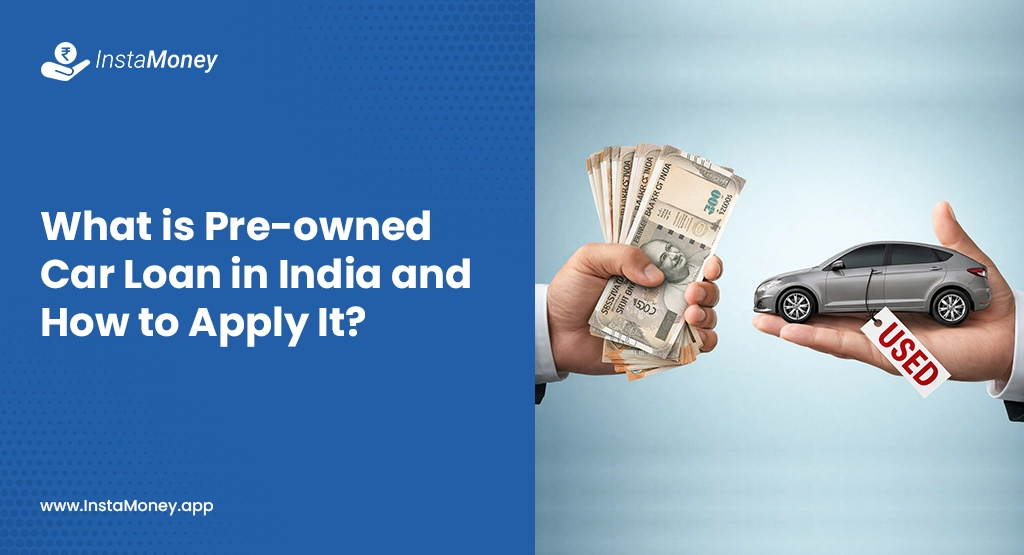
A pre-owned car loan (or used car loan) is a financing option that lets you buy a second-hand car without paying the full amount upfront. Instead, you borrow money from a bank or financial institution and repay it in monthly installments called EMIs. The car you purchase acts as collateral or security for the loan. This setup makes it easier for you to buy a dependable used car while still being able to handle your money well.
A used car loan has a lot of benefits that a new car loan doesn’t have.
The used car market in India has grown a lot. In 2024, it was worth about US$8.77 billion, and by 2029, it is expected to be worth US$18.04 billion. This growth shows how more people are choosing pre-owned vehicles as a smart financial decision.
What Are the Key Benefits of Getting a Pre-owned Car Loan?
Pre-owned car loans have become increasingly popular for good reasons. It includes:
- Lower Down Payment Requirements: Most of the time, you only need to put down 10% to 20% of the car’s purchase price to get a loan for a used car. This is a lot less than what most new car loans require. It helps you save more and have financial flexibility with lower down payment.
- Affordable Monthly Payments: Since the price of a used car is lower than a new one, your loan amount decreases. This directly reduces your monthly EMI. For instance, if you’re financing a ₹5 lakh car, you’ll pay less each month than someone financing a ₹10 lakh new car.
- Slower Depreciation Rates: The biggest financial advantage of buying a pre-owned car is that it depreciates much more slowly. A new car loses 15-20% of its value in the first year itself. A pre-owned car that’s already 3-4 years old loses very little value from that point onward. This protects your financial investment.
- Flexible Repayment Options: Lenders offer various loan tenure choices to suit your financial situation. You can select shorter tenures with higher monthly payments or longer tenures with smaller EMIs. Many lenders even permit partial or full prepayment without penalties, giving you control over your loan.
- Reduced Insurance Costs: Second-hand vehicles typically attract lower insurance premiums compared to new cars. This further reduces your overall ownership cost.
- Minimal Documentation: Unlike personal loans, car loans secured by the vehicle itself require fewer documents. You mainly need proof of identity, address, income, and vehicle details.
- Quick Approval Process: Most lenders approve pre-owned car loans within 24 to 48 hours after document submission. Some institutions claim approval in as little as 4 hours.
- Higher Loan-to-Value Ratios: You can borrow up to 80-95% of the car’s value depending on the vehicle’s age and your credit profile. This means lower down payment requirements.
Who Can Apply for a Pre-owned Car Loan in India?
In order to apply for a pre-owned car loan in India you must fulfil below common eligibility criteria:
- You must be at least 21 years old at the time of application.
- The loan should be fully repaid before you turn 60-70 years old, depending on the lender. Self-employed individuals sometimes face slightly higher age requirements.
- Salaried individuals typically need a minimum annual income of ₹1.80 lakh to ₹2.50 lakh.
- Salaried applicants must have worked for at least 6 months to 1 year with their current employer and at least 2 years total work experience.
- Self-employed individuals usually need to show at least ₹2.50 lakh to ₹3 lakh annual income.
- Self-employed individuals should have been in business for a minimum of 2 years with proper documentation.
- A CIBIL score of 700 or higher significantly increases your chances of approval and helps you get better interest rates. Even with a lower score, some lenders may approve you if other factors are favorable.
- You must be an Indian resident or citizen.
- Your past loan repayment history should be clean. Defaulting on previous loans makes approval difficult.
What Documents Do You Need to Provide?
Below is the list of documents you may be required while applying for used car loan. Requirement of documents may vary from lender to lender.
Identity and Address Proof:
- Aadhar card
- Passport
- Voter ID card
- Permanent Driving License
- NREGA job card (if applicable)
Income Proof:
- Latest 3 months of salary slips (for salaried individuals)
- Latest Income Tax Returns (ITR) for 2 years (for self-employed)
- Latest audited balance sheet and profit-loss statement (for business owners)
- Bank statements for the last 3-6 months
Age Proof:
- PAN card
- Driving license with date of birth
- Passport
- Birth certificate
Vehicle-Related Documents:
- Vehicle Registration Certificate (RC)
- Insurance policy copy
- Proof of address for the vehicle
- RC transfer documents (if applicable)
Banking Details:
- Copy of your bank account statement
- Cancelled check
- Bank account opening proof
Signature Verification:
- Passport copy
- Photo driving license
- Credit card statement with card copy
- Banker’s verification letter
Having all documents ready before you apply speeds up the approval process significantly.
How Do You Apply for a Pre-owned Car Loan?
Below are the exact steps you need to follow ensuring your used car loan application gets approved:
Step 1: Check Your Eligibility: Before applying, visit the lender’s website and check if you meet their eligibility criteria. Most banks have online eligibility checkers that take just a few minutes. You can also call their customer service for clarification.
Step 2: Research and Compare Lenders: Different lenders offer different interest rates, processing fees, and tenure options. Even a 1% difference in interest rate can save you thousands of rupees over the loan tenure. Compare at least 3-4 options before deciding.
Step 3: Decide on the Car and Loan Amount: Choose the pre-owned car you want to purchase. The car should ideally be no more than 5-8 years old and in good condition. Determine how much you need to borrow and what down payment you can comfortably manage.
Step 4: Start the Application: Go to your chosen lender’s website and click “Apply Now” or visit their nearest branch. Fill out the loan application form with your personal details, employment information, and the vehicle details you’re interested in financing.
Step 5: Submit Required Documents: Upload all necessary documents either online or submit them physically at the branch. Ensure every document is legible and matches the information you provided in the application form.
Step 6: Document Verification: The lender’s team will verify all your submitted documents. They’ll check your credit score, income proof, employment continuity, and vehicle details. This step typically takes 24-36 hours.
Step 7: Vehicle Inspection and Valuation: The lender will arrange for an inspection of the car you want to purchase. This determines the vehicle’s current market value and helps set the loan amount. A professional inspector checks the car’s condition, mileage, and mechanical status.
Step 8: Receive Loan Approval: Once all verifications pass, the lender sends you a sanction letter outlining the loan terms, tenure, interest rate, and monthly EMI amount. Review this carefully to ensure all details are correct.
Step 9: Complete Final Formalities: Sign all required documents and complete any remaining formalities like providing final approval for disbursement.
Step 10: Get Your Loan Disbursed: The lender transfers the approved loan amount to your bank account or directly to the car seller’s account. You can now complete your car purchase and register it in your name.
The entire process from application to disbursement usually takes 48-72 hours for most lenders, though some offer faster turnaround.
What Factors Do Lenders Consider When Approving Your Used Car Loan?
Each lender has its own criteria which taken into consideration while approving your second-hand car loan application. Below are some common points you should be aware of:
- Your Credit Score: Your CIBIL score is one of the most important factors. A higher score makes approval easier and gets you better interest rates. Lenders typically prefer scores above 700.
- Your Income and Employment History: Lenders want proof that you have stable, consistent income. They look at your salary growth over the years and check for any gaps in employment. Self-employed individuals need to show at least 2 years of business continuity.
- Your Loan-to-Value Ratio: This is the percentage of the car’s value you want to borrow. If the car is worth ₹10 lakh and you want to borrow ₹8 lakh, your LTV is 80%. Lower LTV ratios are more favorable for approval.
- Your Existing Debt Obligations: Lenders check how much you already owe through other loans or credit cards. If your total monthly debt payments exceed 40-50% of your income, approval becomes difficult.
- Your Payment History: If you’ve paid previous loans on time, it works in your favor. Late payments or defaults on past loans hurt your chances.
- The Car’s Age and Condition: Older vehicles are riskier for lenders because their resale value is lower. Generally, cars older than 8-10 years have fewer financing options.
- Your Employment Type: Salaried individuals typically get approved faster than self-employed applicants because their income is more predictable. However, both categories can get approved with proper documentation.
What Vehicle Factors Affect Your Second-Hand Car Loan Approval?
The specific car you choose to finance determines whether lenders approve your full requested amount or reduce it by 20-30%. Below are the common vehicle factors lenders consider while analysing your application:
- Car Age: A 5-year-old car is easier to finance than a 9-year-old vehicle. Newer used cars get approved faster with better loan-to-value ratios because they retain more resale value.
- Mileage and Condition: Cars with lower mileage (below 40,000-60,000 km) fetch better valuations. Well-maintained vehicles with complete service records are valued higher, allowing you to borrow larger amounts.
- Brand and Model: Popular, reliable brands like Maruti Suzuki, Toyota, Hyundai, and Tata retain value better than niche brands. Lenders finance established models more readily because their resale markets are stronger.
- Accident History: A clean accident history boosts the car’s valuation significantly. Vehicles with major accident claims or previous insurance total loss declarations face financing restrictions.
- Fuel Type and Engine Specifications: Petrol cars typically depreciate slower than diesel variants in India due to regulatory considerations. Engine condition through a mechanical inspection impacts the final loan amount.
7 Common Mistakes to Avoid When Applying for a Pre-Owned Car Loan
Most pre-owned car loan applications get rejected within 24-48 hours due to preventable mistakes that cost applicants thousands of rupees in lost opportunities and delayed purchases. Below are the common mistakes you should avoid while applying for pre-owner car loan in India:
- Submitting Incomplete or Wrong Documents: Always double-check your documentation against the lender’s requirements. Incomplete applications lead to rejection or delays.
- Overlooking Hidden Charges: Beyond the interest rate, lenders may charge processing fees (0.5-2% of loan amount), prepayment penalties, late payment charges, and insurance costs.
- Ignoring the Car’s Condition: The vehicle you finance must be in good working condition. Very old, poorly maintained, or heavily damaged cars get rejected by lenders.
- Stretching Your EMI Budget: While longer tenures mean lower monthly payments, they also increase total interest costs. Use online EMI calculators to find a balance that doesn’t strain your monthly budget.
- Not Improving Your Credit Score First: If your CIBIL score is below 700, spending 2-3 months paying all bills on time and reducing credit card usage can improve it significantly, leading to better loan terms.
- Choosing the Wrong Lender: Different lenders have different strengths. Some offer the lowest rates, while others provide fastest approval. Consider your priority before choosing.
- Lying About Your Income or Employment: Lenders verify every claim you make. Providing false information can lead to application rejection or legal consequences.
How InstaMoney Can Help You Finance Your Pre-Owned Car Purchase?
While pre-owned car loans from banks take 24-48 hours for approval and require extensive vehicle documentation, InstaMoney offers a faster alternative through instant personal loan up to ₹1,00,000.
InstaMoney approves your loan within minutes with 100% digital process using only four documents (a selfie, PAN card, Aadhar or address proof, and bank statement.)
Unlike car loans that check CIBIL scores and vehicle age restrictions, InstaMoney approves applicants between 18-45 years old with minimum monthly income of ₹12,000, regardless of credit score. You get flexible loan tenure and amounts to cover your pre-owned car purchase, down payment, or registration costs without the typical vehicle inspection delays.
With ₹17,000+ crores disbursed and 3+ million users across India, InstaMoney provides quick access to funds for your pre-owned car purchase in days instead of weeks.
FAQs about Pre-Owned Car Loan
In India, the interest rates on loans for used cars range from 8.65% to 19% per year. This depends on your credit score, how stable your income is, and how old the car is. Most lenders offer rates between 10% and 16% per year for people with CIBIL scores over 700 and steady jobs. Starting at 11.99%, repurchase agreements are available, and starting at 13.99%, refinance options are available. When it comes to interest rates, newer used cars (3–5 years old) with a good service history get lower rates. Cars that are 9 years old or older usually get rates of 14–16% or higher, depending on how much they have lost value.
Processing fees for pre-owned car loans typically range from 0.5% to 5% of the loan amount plus GST, with most lenders charging 1-2%. Additional charges include documentation fees (₹500-₹800), RC collection fees (₹600), stamp duty at actuals, and vehicle valuation charges (₹800 for used cars). Late payment penalties range from 2-5% per month plus GST. Prepayment charges apply only within 24 months of loan origination at 2-3% plus GST. Total upfront charges usually total ₹3,000-₹5,000 depending on loan amount and lender. These numbers may vary from lender to lender.
Most of the time, it takes 24 to 48 hours to get approved for a used car loan after you send in all the paperwork. Some lenders will approve you within 4 hours of getting all the paperwork. The steps include checking the documents right away (2–4 hours), inspecting and valuing the car (24–36 hours), and giving the final loan approval (12–24 hours). After approval, the money is sent directly to the car seller or your bank account within 48 to 72 hours. To get approved faster, you need to fill out all the paperwork correctly and apply in the morning before the lender’s cut-off times. The whole process, from applying to owning the car, takes 3 to 5 business days.
You can get a loan for a used car without showing proof of income (like pay stubs or an ITR) if you have other documents, like six months of bank statements, letters from your employer, or business registration papers. Self-employed people and freelancers can give income certificates from their accountants or CA-certified financial statements. But lenders may impose stricter rules, such as higher interest rates (2–4% higher than normal), bigger down payments (25–30% instead of 10–20%), and stronger CIBIL scores (750+ preferred). Some lenders will only approve loans without formal income documentation if the applicant has a co-applicant with verified income.
After the loan is approved, the money will be sent to the car seller or your bank account within 48 to 72 hours. You finish buying the car and then go to the Regional Transport Office to transfer the registration using the NOC and transfer documents that the lender gave you. The lender puts a hypothecation mark on the RC until the loan is paid off in full. The car is used as collateral for the loan. The loan agreement says that your first EMI is due 30 to 60 days after the loan is paid out. To make sure you pay your EMIs on time, set up automatic payment mode with your bank. For tax and legal reasons, keep all your loan papers, insurance papers, and vehicle registration papers during the repayment period.
Conclusion
With a pre-owned car loan, you can get a dependable car without having to pay a lot of money up front. If you meet the basic requirements and have your paperwork ready, the application process is simple. Most people can afford to buy a used car because the interest rates are competitive, the approval process is quick, and they have a lot of financial freedom.
With proper planning and by following the steps outlined here, you can successfully secure a pre-owned car loan and drive home the vehicle of your choice within a few days.